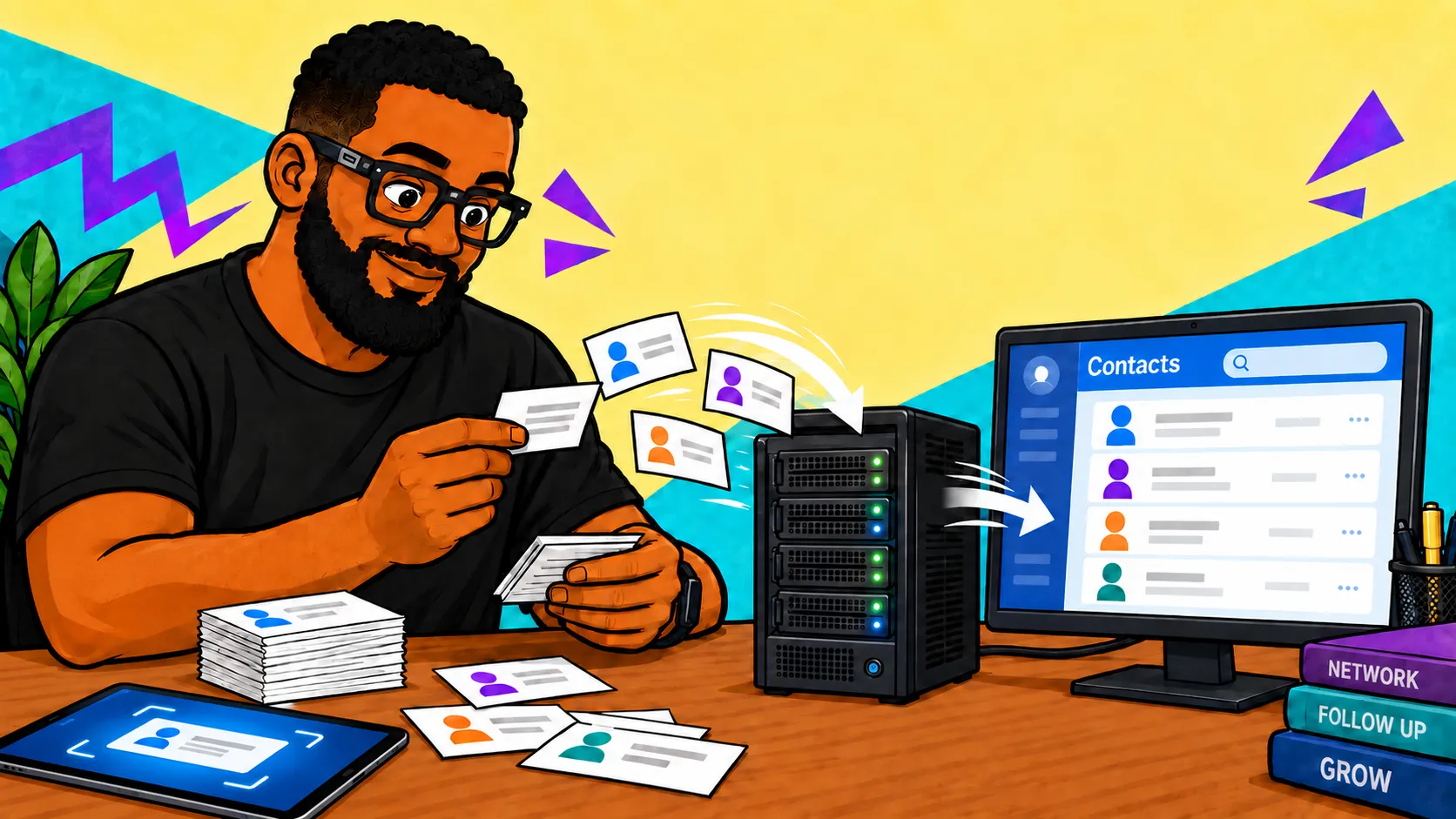
I used to come home from chamber mixers with a stack of business cards rubber-banded together on my desk, fully intending to do something with them that weekend. Three weeks later I'd find the stack again, flip through it, and have no idea why I spoke to half of these people. A name, a title, a logo, and nothing else. Whatever we'd actually talked about, the thing that made the conversation worth having, was already gone.
For a long time I chalked this up at me being really bad at follow-up. But that wasn't the main issue. The real problem is that a stack of cards was never a system in the first place. A system tells you what to do next and a pile just proves you showed up and collected some souvenirs.
Without a system at a networking event, you're essentially just collecting Yu-Gi-Oh cards.
The Problem Isn't Your Follow Up, It's That You Never Had a System
Here's a quick little test you can perform right now. Pick up any card on your desk right now and try to answer three questions without guessing: where did you meet this person, what did you actually talk about, and what were you supposed to do next. If you can't answer all three in five seconds, the card isn't doing its job, and it was never going to no matter how disciplined you got about follow up.
Where did you meet
What you talked about
What happens next
That's really all a system is here. Three questions, written down somewhere, the same day you meet someone. It doesn't need software. A notes app, a sticky note, the back of the card itself, doesn't matter. What matters is that the information exists somewhere other than your memory, because your memory is going to be full of the other forty people you met that same afternoon.
Three Questions Turn a Stack of Cards Into Something You'll Actually Use
Say you meet someone at your table who mentions they just took over bookkeeping for three other small businesses in the area. If the only thing that survives that conversation is their card, you've lost the one detail that made them worth remembering. Write down who they are, what they said, and what happens next, even if what happens next is just "send a quick email this week," and that card turns into something you can act on instead of something you feel vaguely guilty about.
I'd rather see someone do this in the plainest tool possible than skip it because they don't have a "real" system yet. A spreadsheet with three columns works and so does a sticky note. The tool doesn't matter until the habit does.
The Card You Hand Out Has the Exact Same Problem in Reverse
Here's the part that I never used to think about, because I was only worried about the cards I was collecting. Every card you hand out that day has the identical problem, just running the other direction. It goes into someone's jacket pocket, gets transferred to a junk drawer, and eventually gets thrown out with the same casual disregard you were just guilty of yourself. You're not exempt from the pile, you're just not the one looking at it.
A QR Code Fixes the Handoff, If It Actually Goes Somewhere Useful
This is where a QR code earns its place, and it's not a tech gimmick, it's just removing a step. Someone scans it, their phone offers to save you as a contact, done. No typing your number in wrong, no card that sits in a wallet until it gets thrown out with a receipt.
Where most people mess this up is the destination. A QR code that dumps someone on your full homepage or a PDF is worse than no QR code at all, because now they have to do work to find the one thing they actually wanted, which was just your contact info. The whole point is removing friction, not adding a scavenger hunt. It's the same philosophy I've written about when it comes to building a CRM around habits people already have instead of asking them to change how they work. Same idea here, never make a prospect dig for info.
One page, one job
My own Connect page is the whole design brief in one example. My company logo, my phone number, my email, and a button that saves my contact info directly to their phone. If someone wants to go further, there's a booking link right there too. That's it. No navigation, no explaining what I do in four paragraphs first.
Carry the Code Even When You Forgot the Cards
A few practical ways to make sure the code is actually there when you need it, since the worst time to think about this is mid-handshake. Print it on the back of your physical card, so it works even if you never open your phone.
Save a screenshot of the code in your phone's photo library or wallet app, so you can pull it up instantly if you run out of cards, which happens more often than anyone plans for. If you want to go a step further, some people put it on their lock screen or a phone case, so it's visible without even unlocking anything.
None of this requires new software. It just requires the code existing somewhere you can get to fast.
Once Both Directions Are Flowing, the Real Question Is Where It All Lives
At this point you've solved both halves of the same problem. You're capturing what comes in instead of losing it to a pile, and you're making it effortless for what goes out to actually land somewhere instead of getting lost in someone else's pocket. That's the whole game. Everyone at that mixer is playing half of it. Almost nobody is playing both.
Once you've got contacts flowing in consistently, the natural next question is where all of it actually lives and what happens to it after the first email. That's exactly what I cover in my post-networking CRM workout, the routine I run on every stack of cards once I'm back at my desk.
Read the CRM Workout →Worth reading once the three-question habit above starts to feel too small for how many people you're actually meeting.
